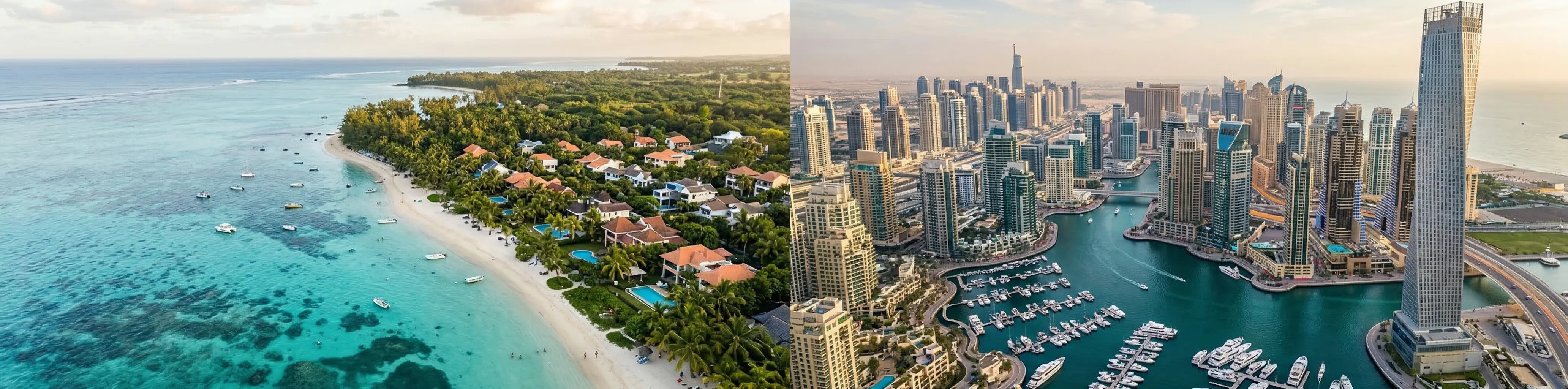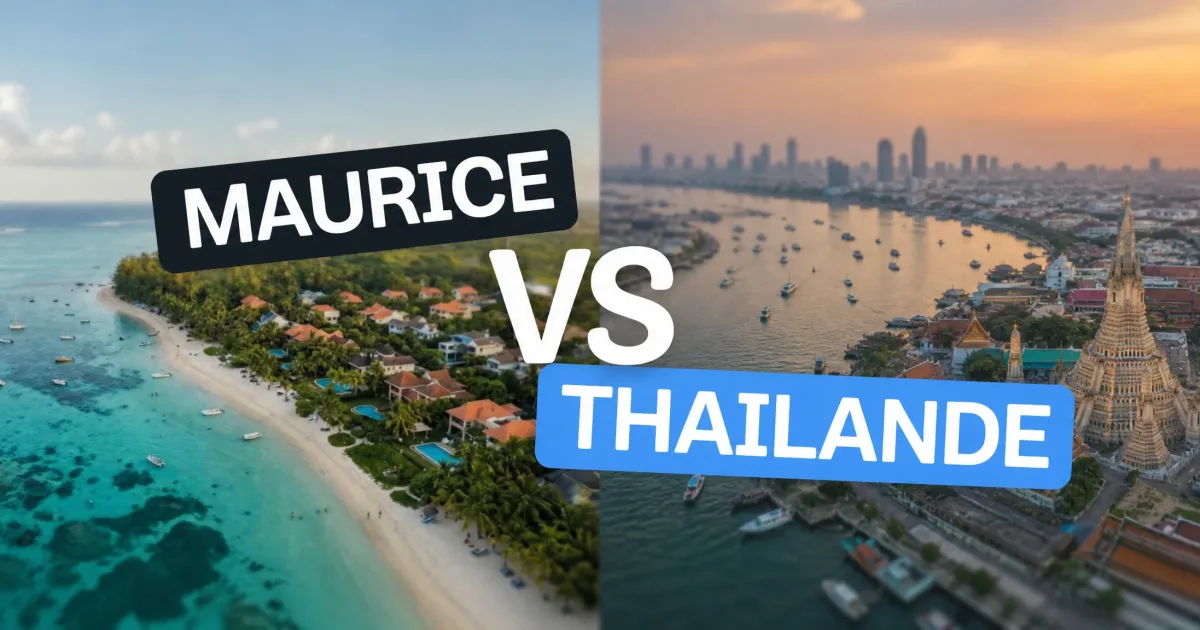
Mauritius vs Thailand comes up in almost every conversation about moving abroad as an entrepreneur or investor. Sunshine, the sea, a gentler cost of living, a tax setup worth studying, strong international communities: on paper, both destinations tick a lot of boxes. But they do not answer the same project.
Thailand is a remarkable place to test Asia, live with more flexibility, enjoy a deep urban and medical offer, and trim some day-to-day costs. Mauritius is often the better fit when the goal is no longer just to live somewhere new, but to build a stable base: residency status, banking, tax, family, a company, retirement or an investment portfolio.
So this is not about declaring one country better than the other. The real question is simpler: do you mostly want to test a new life, or structure a durable setup?
| Criterion | Mauritius | Thailand |
|---|---|---|
| Typical project | Structured residency | Flexible life / long-stay test |
| Visas | Investor, self-employed, professional, retirement permits | DTV, LTR, retirement, non-immigrant by profile |
| Banking | Fits naturally into a residency path | Possible, but varies by visa, bank and branch |
| Tax | Flat, readable regime to structure | Needs framing if tax resident with remitted foreign income |
| Daily cost | More stable, sometimes higher | Often more affordable |
| Environment | Island air, short distances | Highly variable by city, season and region |
Visas: Thailand is strong for testing, Mauritius for settling
Thailand made a genuine move toward mobile expats with the Destination Thailand Visa, usually called the DTV. It targets workcation profiles, digital nomads and freelancers, some dependents, and people coming for so-called "soft power" activities: Thai cooking classes, Muay Thai, training, medical treatment, seminars or cultural events. The promise is attractive: a multiple-entry visa valid for 5 years, with stays of up to 180 consecutive days per entry, and official proof of funds of 500,000 THB, roughly USD 14,000 at recent exchange rates.
For someone who wants to discover Asia, spend several months a year in Thailand, work remotely for clients or employers outside the country, and keep a lot of mobility, it is a useful tool. Thailand also offers the Long-Term Resident Visa, or LTR, which is more selective and designed for wealthy, retired, highly skilled or remote-work profiles meeting higher thresholds.
To compare fairly with Mauritius, you have to look at the conditions per profile. The DTV is the most accessible route for a mobile freelancer, but it does not replace a real local status for running a business inside Thailand. The LTR is longer term, but far more selective.
| Profile | Mauritius | Thailand |
|---|---|---|
| Freelancer / self-employed | Self-employed permit up to 10 years by file | Documented remote/freelance activity, 180 consecutive days max per entry |
| Company / entrepreneur | Investor permit tied to a Mauritian company | DTV possible for remote foreign activity; a local Thai business is far more complex |
| Wealth / portfolio investor | Residency by real estate or permit by project | LTR Wealthy Global Citizen: high net worth plus significant Thai investment |
On the Thailand side, what this means in practice
For a freelancer or self-employed professional, the DTV is usually the most readable entry point: you generally need proof of funds of at least 500,000 THB and evidence of remote activity, such as a foreign contract, a statement of activity or a professional portfolio. It suits someone who works for clients or companies outside Thailand.
For a company or entrepreneur, the nuance matters. If your company is foreign and you work remotely from Thailand for clients outside the country, the DTV or, for more established profiles, the LTR Work-from-Thailand can be considered. But if the goal is to own your local Thai company, sell on the ground, hire locally or sign Thai contracts, you change the subject entirely. You then have to deal with local company law, the Foreign Business Act, restrictions on certain activities, work authorization, capital, banking and accounting compliance. It is not impossible, but it is markedly more complex than a simple remote-work visa.
For a wealth or portfolio investor, the LTR Wealthy Global Citizen is closer to a selective long-term visa. It targets profiles able to evidence at least USD 1 million in assets, a Thai investment of at least USD 500,000 in accepted categories (Thai government bonds, direct investment in Thai companies or Thai real estate), plus sufficient health coverage or an eligible bank deposit. It is a genuine long-stay tool, but it does not target the same audience as the DTV.
In Mauritius, the logic is different. The main statuses are built around a settlement project: the investor permit, the self-employed permit, the professional permit, the retirement permit, residency through real estate investment, or the Premium Visa for a more flexible stay. These settlement permits can run up to 10 years depending on the category and contract duration, with the option to attach dependents and, under conditions, to consider longer-term residency.
The right reflex
If your priority is to test a new life without committing too quickly, Thailand clearly deserves a close look. If your priority is to build a personal, family, tax and banking base, Mauritius offers a framework designed more directly for that kind of project.
Work and business: flexibility or a professional framework?
Thailand has become one of the world's great destinations for freelancers, creators, mobile entrepreneurs and remote workers. Bangkok, Chiang Mai, Phuket and Koh Samui offer international communities, cafes, coworking spaces, a dynamic social life and real depth of services.
That is a major advantage. Many profiles do not need a full setup at the start: they want to live better, cut their costs, meet other entrepreneurs, travel the region and keep their clients abroad.
Once the project gets more structured, however, the question changes. Setting up a local Thai company, hiring locally, opening a business account, attaching your family, documenting your tax residency or securing a clear multi-year status all demand a much finer reading of the local framework.
This is often the part entrepreneurs discover after the fact: Thailand is very easy to love as a place to live, but creating your own local structure can be heavy if your activity falls in a restricted sector or if you want to control it directly as a foreigner. Mauritius is smaller, less intense, less of an "Asian hub". But for an international entrepreneur or freelancer who wants a readable base, a coherent residency status and a legal environment that is simpler to explain to banks, clients, insurers or advisers, the island can be more practical.
Banking: a point to plan before you settle
Banking is an excellent reality check. You can love a country, live there for months, rent an apartment, build your routines, and still struggle to open a full local bank account.
In Thailand, opening an account is often possible with a solid status: a non-immigrant visa, a work permit, a retirement visa, an LTR or a well-documented long-stay file. But for more mobile profiles, especially holders of a tourist visa, a visa exemption or a DTV, the situation can become far less certain.
The point is not to say it is impossible. Some people manage it, sometimes with the right bank, the right branch, the right documents or local professional help. But it is not always predictable. KBank, for instance, states non-immigrant visa requirements for foreigners and explicitly excludes several tourist statuses, including the DTV, from its standard foreigner accounts. Bangkok Bank leaves more room for branch-level assessment and also offers foreign-currency accounts for non-residents, but that is not the same as a local everyday account in baht with the fluidity you would expect.
In Mauritius, opening a bank account is not automatic either. Banks apply serious KYC procedures: source of funds, activity, supporting documents, address, residency status, overall coherence of the file. But that step slots more naturally into a residency, company-formation, investment or retirement path. With BlueVisa, you are guided through preparing the banking file, aligning your supporting documents and connecting it all to your permit or settlement project.
Worth watching
For a long-term move, the question is not only "can I stay in the country?". It is also: can I receive money there, pay locally, get a card, manage my insurance, justify my flows and keep my administrative project running day to day?
Mauritius vs Thailand tax: freelancer, company, investor; three different comparisons
Tax is one of the topics where shortcuts spread fastest. But comparing Mauritius and Thailand on a single headline rate makes little sense. The right comparison depends on your profile: freelancer, operating company or investor.
| Profile | Mauritius | Thailand |
|---|---|---|
| Freelancer / consultant | Progressive 0–20% up to Rs 12M (35% above); foreign income taxed if received in Mauritius | Brackets up to 35%; foreign income taxed if remitted |
| Operating company | Company at 15%; dividends from Mauritian companies generally exempt | Company at 20%; dividends often subject to withholding |
| Investor / capital gains | No capital gains tax | Capital gains often treated as taxable income |
1. For a freelancer or consultant
For a freelancer, the first question is personal: where are you a tax resident, and where does your income land? In Thailand, if you stay 180 days or more in the tax year, you can become a tax resident. The personal income tax scale can reach 35%, and foreign income earned from 2024 onward has to be analyzed when remitted to Thailand, as the Thai Revenue Department and the PwC Thailand tax summaries point out.
In Mauritius, personal income is taxed on a progressive scale (0% up to Rs 500,000, then 10%, 20% up to Rs 12M and 35% above), as confirmed by the Mauritius Revenue Authority. Foreign income of a resident is taxable in Mauritius to the extent it is received in Mauritius. For an international freelancer or consultant, the appeal of Mauritius is mainly the readability of the path: the self-employed permit, the bank account, tax residency and your activity can be planned together.
2. For a company
For an operating company, the comparison shifts. In Thailand, setting up a local company can make sense if you have a real Thai or Asian business: local clients, employees, stock, logistics, partners, a commercial presence. The standard corporate income tax rate is 20% according to the PwC Thailand data, with VAT, withholding taxes and cross-border payments to plan for.
In Mauritius, a resident company is generally taxed at 15% on its net income. The country can be more readable as a base for an international company; a consultant, an agency, a services activity or some e-commerce businesses selling mostly outside the domestic market. That does not mean an absence of rules: substance, banking, invoicing, the Mauritian VAT at 15% and your flows all have to be coherent.
3. For an investor: capital gains, dividends, portfolio
For an investor, the main topic is not just the income tax rate. You have to look at capital gains, dividends, shareholdings, financial income and the holding structure.
Mauritius levies no capital gains tax in the classic sense. For a company, dividends received from Mauritian companies are generally exempt, as detailed in the PwC Mauritius tax summaries. In Thailand, capital gains realized by a company are generally treated as taxable income, and dividends can be subject to withholding tax depending on the situation. For a financial portfolio, shareholdings or a holding company, the exact structure therefore matters enormously.
These comparisons give you a reading grid, not a universal tax answer. The outcome always depends on your real tax residency, where your clients are, where the company is managed, the bank you use, the treaties that apply and how your flows are documented.
Cost of living: Thailand often wins on the daily budget
On cost of living, let us be honest: Thailand often keeps the edge. Depending on the city and the lifestyle, restaurants, services, local transport, some rentals, routine healthcare and leisure can be very competitive.
Here are indicative orders of magnitude for an expat profile, in EUR for reference. Thai figures vary widely by city: Chiang Mai is noticeably more affordable than Bangkok or Phuket.
| Item | Mauritius | Thailand |
|---|---|---|
| 2-bed apartment rental (sought-after area) | €700 – €1,400/mo | €450 – €1,100/mo |
| Groceries (couple) | €400 – €600/mo | €300 – €500/mo |
| Meal at a local restaurant (1 person) | €8 – €15 | €3 – €8 |
| Fiber internet | €25 – €40/mo | €15 – €25/mo |
| Household help (full-time) | €300 – €500/mo | €250 – €450/mo |
| Daily transport (vehicle + fuel) | €150 – €300/mo | €100 – €250/mo |
| International school (1 child) | €3,000 – €8,000/yr | €6,000 – €18,000/yr |
Chiang Mai is not Bangkok. Bangkok is not Phuket. Phuket is not a quieter local island. But broadly, for a single person, a mobile couple, a freelancer or an entrepreneur who wants to optimize day-to-day spending while living in a very dynamic environment, Thailand is hard to beat.
Mauritius can be more expensive on several lines: imports, vehicles, certain everyday products, housing in the most sought-after areas, international schools and health insurance. In return, the island offers another kind of value: shorter distances, an English-friendly bilingual environment, a stable living framework, and easier family and administrative planning.
Mauritius in brief
- A more structured residency base
- English-friendly, bilingual environment
- Short distances
- More coherent permit + banking path
- Strong fit for families, retirement and companies
Thailand in brief
- Often a lower daily cost
- Asian energy and huge variety
- Very developed private healthcare
- Strong nomad communities
- Ideal to test and stay mobile
- Higher personal income tax
Family, schools and language: Mauritius is often the easier base
For a single person or a couple without children, Thailand offers remarkable freedom. You can choose Bangkok for urban energy, Chiang Mai for the creative community and cost of living, Phuket or the islands for the sea, or move with the seasons.
With children, the reading grid changes. International schools exist in both countries, but the daily environment counts as much as the curriculum. In Mauritius, the English-and-French mix, the size of the island, the proximity of schools, the international community and the steadier rhythm can make integration easier.
In Thailand, the international school offer is very strong in the main centers, notably Bangkok and Phuket. But the language barrier outside expat circles can be sharper, and the experience varies a lot by city. For some families that immersion is a richness. For others, it adds a layer of complexity.
Pollution and climate: a factor to check before you choose
Climate and air quality are often underrated in expat comparisons. Yet they are very concrete topics: children, sport, sleep, allergies, respiratory health, fatigue, going out, commutes, the choice of neighborhood.
In Thailand, the experience varies sharply by region. Bangkok can see episodes of urban pollution and fine particles. Chiang Mai and the North are regularly affected by the burning season, with periods of degraded air quality. The islands and the South can offer a very different experience, but with their own rainy and monsoon seasons.
Mauritius is not perfect: the austral summer can be hot and humid, and the official cyclone season runs from November to May. But the climate stays more readable on a small island. The trade winds, the island context, the short distances and the absence of a huge metropolis make daily life more predictable for many families.
How to compare properly
Do not compare "Mauritius" to "Thailand" in the abstract. Compare Grand Baie, Tamarin or Moka to Bangkok, Phuket, Chiang Mai or Koh Samui. In Thailand, the choice of city changes almost everything: cost, pollution, schools, climate, healthcare, social life and transport.
Healthcare and safety: two strong cases, with different strengths
Thailand has a very strong reputation in private healthcare. Bangkok and the main centers have international hospitals, specialists, top-tier medical infrastructure and long experience with foreign patients.
Mauritius operates at a different scale. The country is smaller, less dense, less urban. For routine care, family life and daily needs, many expats value the simplicity and the proximity. For certain specialized procedures, it can be necessary to plan ahead, insure properly or budget for medical evacuation depending on your level of cover.
On safety, both destinations can offer a good living environment for expats. The difference plays out more on the setting: a large Asian city, touristy islands, very international districts, or a compact island with a slower pace.
The verdict: it all comes down to your profile
There is no wrong choice, only different priorities.
Thailand is often the better fit if you want to test Asia, stay mobile, cut your cost of living, enjoy an international social scene, access excellent private healthcare and keep a lot of geographic flexibility.
Mauritius is often the better fit if you want a clear, attractive tax framework, a long-term permit, a bank account opened within a coherent path, the ability to attach your family, the option to start a company, invest or prepare for retirement.
In other words: Thailand remains one of the best destinations to experience Asia with flexibility. Mauritius is often easier to structure as a residency base and for entrepreneurs and investors, that structure is precisely what turns a move into a long-term plan.
Frequently asked questions
Mauritius vs Thailand: which destination is cheaper?
Thailand is often cheaper for day-to-day living, especially for a single person, a mobile couple or a freelancer. Mauritius can cost more on imports, certain rentals, vehicles and international schools, but it offers a more compact, more structured base for a family or wealth-planning move.
Does the Thai DTV let you settle long term?
The DTV is useful for spending long periods in Thailand, especially as a remote worker or workcation profile. It is valid for 5 years on a multiple-entry basis, but each stay is capped at 180 consecutive days per entry. It should not be confused with a full residency, banking, tax and family-settlement path. For some profiles, the LTR or another visa will be a better fit.
Is it easy to open a bank account in Thailand?
It is workable with a solid status, such as a non-immigrant visa, a work permit, a retirement visa or an LTR. It is far more uncertain with a tourist visa, a visa exemption or a DTV. Some banks, including KBank, explicitly exclude the DTV from their standard foreigner accounts, and practices vary by bank and branch. In Mauritius, banking is still demanding, but it slots more naturally into a permit, company, retirement or investment path.
Is starting a company in Thailand simpler than in Mauritius?
Not necessarily. In Thailand, setting up your own local company means dealing with the Foreign Business Act, activity restrictions, work authorization, capital, banking and accounting compliance. In Mauritius, the investor permit, self-employed permit, banking and residency tracks are often easier to align for an international entrepreneur.
Mauritius vs Thailand: which is simpler on tax?
Neither destination should be taken lightly. Thailand can tax foreign income remitted by a tax resident, while Mauritius applies a progressive personal income tax (0% up to Rs 500,000, then 10%, 20% up to Rs 12M and 35% above) and taxes foreign income received in Mauritius. For many international profiles Mauritius is easier to structure, but personal advice is essential.
Mauritius vs Thailand: what is the tax position for an investor?
Mauritius levies no capital gains tax in the classic sense, and dividends received from Mauritian companies are generally exempt for companies. In Thailand, capital gains are often treated as taxable income and dividends can be subject to withholding tax depending on the situation.
Official sources
Tax and immigration rules are sensitive topics, so always cross-check against the official authorities:
- Economic Development Board (EDB) the official agency for Mauritian residence and occupation permits
- Mauritius Revenue Authority (MRA) income tax rates and double-taxation treaties
- Thai Revenue Department Thailand personal and corporate income tax
Torn between flexibility in Asia and a structured base in Mauritius?
Before picking a neighborhood or a school, the most important step is identifying the right status: the investor permit, the self-employed permit, the retirement permit, the Premium Visa or residency by investment. BlueVisa helps you clarify the right status before you commit to the paperwork.
Discuss my project