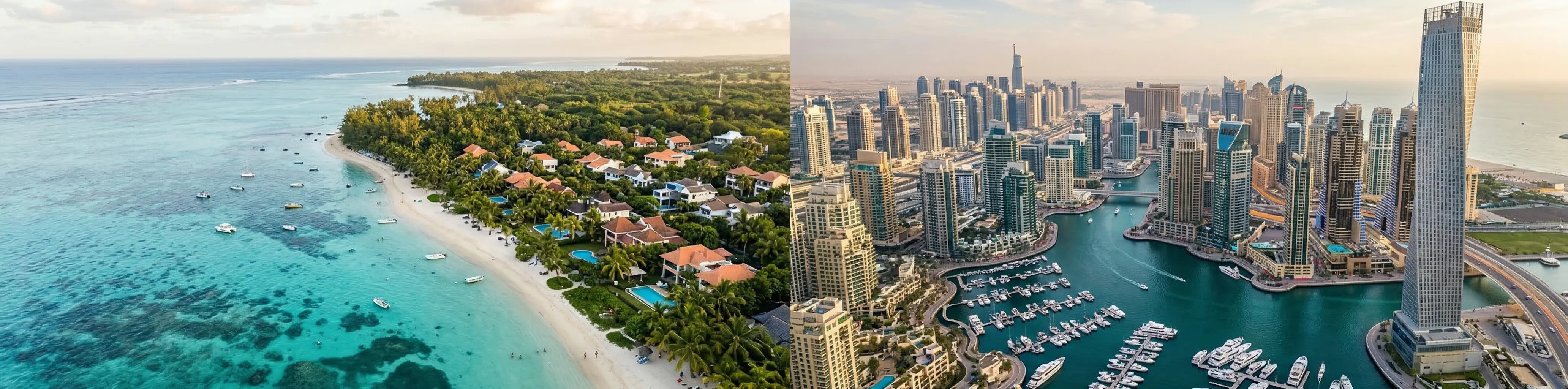
Two destinations, two very different philosophies of life. On one side, Mauritius and its laid-back tropical lifestyle. On the other, Dubai and its supercharged urban scale. For families, expats and entrepreneurs from the UK, South Africa, India, Europe and beyond, the Mauritius vs Dubai question is rarely clear-cut. Here is a detailed, head-to-head comparison to help you decide.
Mauritius vs Dubai at a glance
Before we dig into each category, here is the quick snapshot. The numbers below are typical mid-market figures for an expat family and will of course vary with neighborhood and lifestyle.
| Criterion | Mauritius | Dubai |
|---|---|---|
| 3-bed family villa | USD 1,200 - 2,500/mo | USD 3,500 - 6,000/mo |
| Full-time household help | USD 300 - 500/mo | USD 700 - 1,200/mo |
| International school / year | USD 3,000 - 8,000 | USD 12,000 - 25,000 |
| Personal income tax | Progressive 0–20% (35% > Rs 12M) | 0% |
| Capital gains tax | 0% | 0% |
| Petrol (per liter) | ~USD 1.20 | ~USD 0.85 |
Cost of living: a gap that changes everything
Housing is usually the biggest line in any expat family budget, and the Mauritius vs Dubai cost of living gap is significant. Cost-of-living indexes consistently rank the Mauritian capital, Port Louis, around 50% cheaper than Dubai for an equivalent standard of living.
In Mauritius, a family 3-bed villa with a garden rents for roughly USD 1,200 to 2,500 a month, depending on the area. Sought-after spots such as Grand Baie, Tamarin and Flic en Flac offer a genuinely pleasant setting at prices that stay accessible.
In Dubai, the equivalent home runs from USD 3,500 to 6,000 a month. Family districts like Arabian Ranches, Jumeirah Village and Dubai Hills command a serious budget, before you factor in agency fees and the typically high security deposit.
Household help: an affordable luxury in Mauritius
Full-time domestic help is a real quality-of-life upgrade for families. In Mauritius it stays very reasonable: budget USD 300 to 500 a month for an experienced housekeeper who handles cleaning, cooking and sometimes childcare. In Dubai, the same support costs USD 700 to 1,200 a month.
Schooling: often the deciding factor
For families with children, schooling can make or break a relocation. Mauritius offers a strong line-up of international schools following British (Cambridge, IB), French (AEFE) and bilingual programs, with annual fees of USD 3,000 to 8,000 per child.
In Dubai, comparable schools charge far more, from USD 12,000 to 25,000 a year per child. For a two-child family, that can mean more than USD 30,000 in annual savings by choosing Mauritius, often with smaller class sizes too.
Did you know?
Because English is an official language of Mauritius and most schooling is in English, children of UK, South African, Indian and international families settle in fast. Mauritius hosts around twenty international schools spanning British, French and IB curricula. Enrollment windows differ by school, so apply early.
Tax: progressive 0–20% income tax (35% above Rs 12M) vs 0% income tax
Tax is where the Mauritius vs Dubai debate gets interesting, because both win in different ways and both crush high-tax home countries like the UK, France or India.
- Dubai (UAE) charges 0% personal income tax, 9% corporate tax above a generous threshold and a low 5% VAT
- Mauritius applies a progressive personal income tax (0% up to Rs 500,000, then 10%, 20% up to Rs 12M and 35% above), plus a powerful set of exemptions
Crucially, Mauritius levies no capital gains tax, no inheritance or estate tax and no annual wealth tax, and it has signed more than 45 double-taxation treaties. For many investors and retirees, that combination produces a very low effective rate while keeping access to a relaxed, nature-led lifestyle. Dubai wins on the headline 0% income figure; Mauritius wins on lifestyle-per-dollar and treaty coverage.
Good to know
Your real tax outcome depends on your nationality, your residency status and the relevant treaty, not on the headline rate alone. Both countries require genuine residence to claim their tax benefits. Always confirm your specific situation with a qualified cross-border adviser before you move.
Climate: tropical breeze vs urban furnace
Climate matters, especially with young children. Both destinations are sunny year-round, but daily life feels very different.
In summer
Mauritius sits between 28 and 33°C, tempered by the Indian Ocean trade winds, so the air stays breathable and outdoor life runs all day. Dubai climbs to 38 to 45°C from June to September, with humidity that can reach 90%, pushing most of daily life indoors into air-conditioned spaces.
In winter
The two converge: 20 to 26°C in Mauritius and 22 to 28°C in Dubai. Winter is the best window to enjoy Dubai, whereas Mauritius stays pleasant the whole year. One hidden cost in Dubai is air-conditioning, which can add USD 150 to 600 a month in summer; in Mauritius the trade winds make AC largely optional.
Safety and ease of getting around
Both rank among the safest places to raise a family. Dubai is consistently rated one of the safest cities in the world, while Mauritius is one of the safest and most politically stable countries in Africa, with low violent crime.
Mobility tells a different story. Dubai's distances are large, so most daily trips take 30 to 45 minutes and a two-car household is almost essential. Mauritius is just 65 km by 45 km, so most journeys take 15 to 25 minutes and one car usually does the job. Petrol is cheaper in Dubai (~USD 0.85/liter vs ~USD 1.20 in Mauritius), but you simply drive far less on the island.
Visas: how you actually get residency
Both destinations make residency achievable, but the routes differ. Dubai relies on free-zone company licenses and its Golden Visa tiers. Mauritius offers a clear ladder of permits depending on your profile:
- Entrepreneurs and investors can secure a 10-year, renewable Mauritius investor permit from USD 100,000 in company capital
- Retirees aged 50 and over qualify for the Mauritius retirement permit by transferring at least USD 2,000 a month from abroad
- Remote workers and digital nomads can use the one-year, renewable Mauritius Premium Visa, with no minimum-investment requirement
For entrepreneurs, Dubai suits high-growth, capital-intensive ventures that need a major global hub. Mauritius suits founders and self-employed professionals who want lower running costs and English- and French-speaking talent, often at a meaningfully smaller entry threshold.
Lifestyle: two visions of the good life
This is where the contrast is sharpest. In Mauritius the sea is ten minutes from almost anywhere, the pace is slower and weekends mean beaches, hikes and local markets. Children grow up outdoors, in a safe, green environment. Dubai delivers exceptional material comfort instead: ultramodern infrastructure, 24/7 services, vast malls and a near-endless menu of indoor leisure.
Mauritius in brief
- Sea and nature within reach
- Relaxed pace of life
- Lower cost of living
- English- and French-speaking
- Safe, green setting for children
Dubai in brief
- World-class infrastructure
- Premium services around the clock
- Unlimited leisure options
- Major international hub airport
- Zero personal income tax
The verdict: it comes down to your priorities
There is no wrong answer in the Mauritius vs Dubai debate, only different priorities. If you want a natural setting, a controlled budget and a calmer family rhythm, Mauritius ticks every box. If you prioritize urban comfort, big-hub business opportunities and access to everything without limits, Dubai is your playground.
For many internationally mobile families, Mauritius offers a rare balance of quality of life, affordability and a gentle pace, in an English-friendly environment that makes settling in straightforward.
Frequently asked questions
Is Mauritius cheaper than Dubai for a family?
Yes, by a wide margin. Cost-of-living indexes put Port Louis roughly 50% cheaper than Dubai. Once you add up housing, international schooling and household help, a family can save several thousand US dollars a month by choosing Mauritius over Dubai.
Mauritius vs Dubai: which has better tax for expats?
Both are highly tax-competitive. The UAE charges 0% personal income tax. Mauritius applies a progressive personal income tax (0% up to Rs 500,000, then 10%, 20% up to Rs 12M and 35% above) with no capital gains, inheritance or wealth tax, plus more than 45 double-taxation treaties. For investors and retirees, Mauritius often delivers a very low effective rate while offering a relaxed, nature-led lifestyle.
Is Mauritius or Dubai better for entrepreneurs and remote workers?
Dubai suits high-growth ventures that need a major global hub and free-zone licenses. Mauritius suits founders and remote workers who want lower running costs, English- and French-speaking staff and a 10-year investor permit from USD 100,000. Remote workers can also use the one-year, renewable Mauritius Premium Visa.
Are international schools good in Mauritius compared with Dubai?
Yes. Mauritius has well-regarded British (Cambridge, IB), French (AEFE) and bilingual international schools, typically at a fraction of Dubai fees. Class sizes are often smaller, and English is an official language, which helps children settle quickly.
Is Mauritius as safe as Dubai for children?
Both rank among the safest places to raise a family. Dubai is consistently rated one of the safest cities in the world, and Mauritius is one of the safest, most politically stable countries in Africa, with low violent crime. Families live comfortably in either.
Official sources
Tax and immigration rules change, so always cross-check the headline figures against the official authorities:
- Economic Development Board (EDB) the official agency for Mauritius residence and occupation permits
- Mauritius Revenue Authority (MRA) income tax rates and double-taxation treaties
Leaning towards Mauritius?
The BlueVisa team guides families, expats and entrepreneurs through every step of relocating to Mauritius: the investor permit, the retirement permit and the Premium Visa for remote workers, plus settling in and the admin that comes with it.
Discuss my project