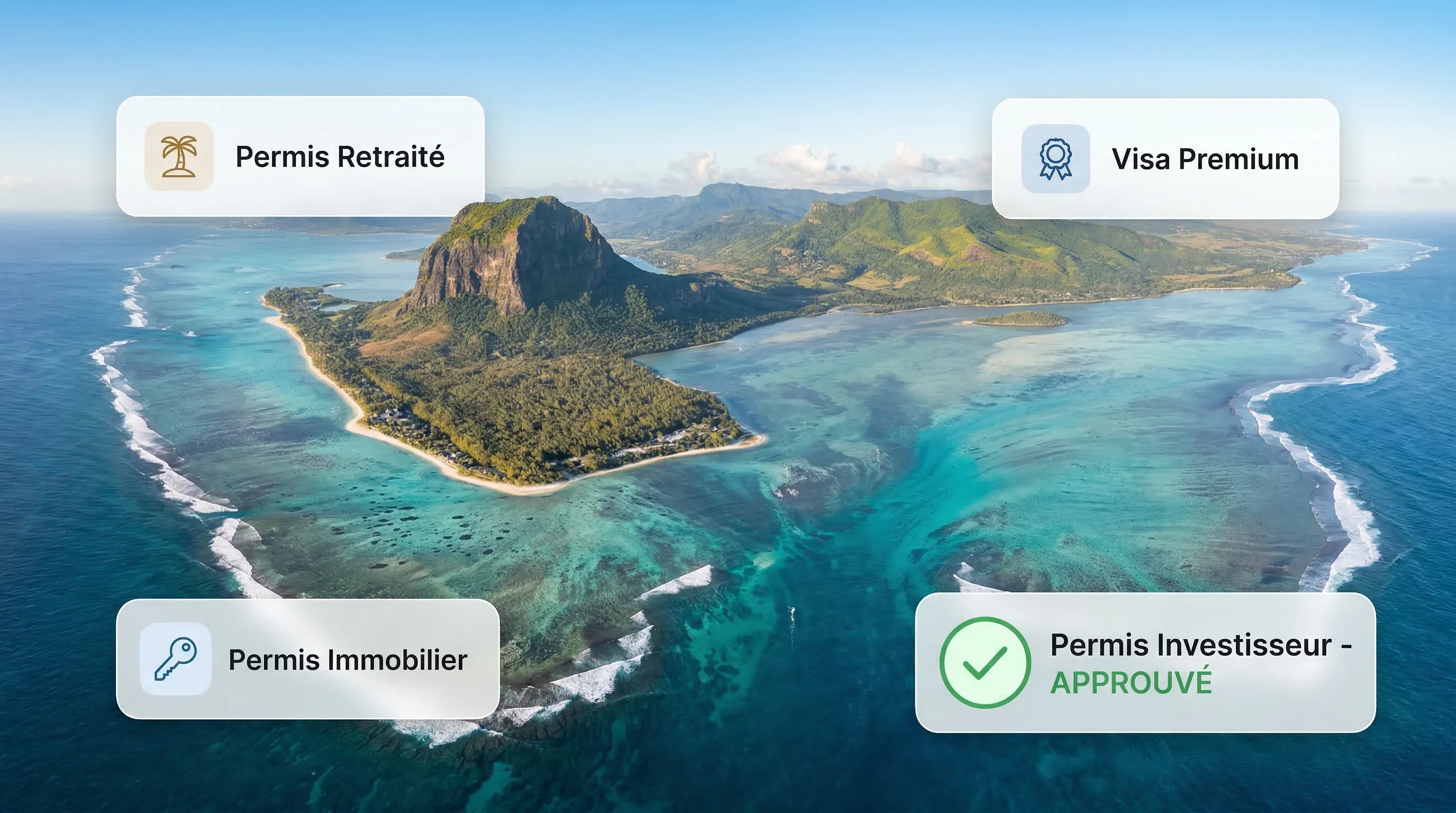
More and more independent professionals choose to freelance in Mauritius: same overseas clients, a setting most people only see on holiday, a time zone close to Europe and a far simpler tax system. If you sell your own expertise rather than run a team, the self-employed permit (officially the Self-Employed Occupation Permit) is usually the right door. This guide covers who qualifies, the income thresholds, the progressive income tax, banking and how it compares with the premium visa and the investor permit.
Before applying, it helps to understand what this permit actually allows, what it does not, the documents the authorities expect, and when an investor permit would serve you better over the long run. Full eligibility lives on our Mauritius self-employed permit page.
Who can freelance in Mauritius on this permit
The self-employed permit is designed for one person running a service activity in their own name: consulting, software development, design, marketing, training, coaching, intellectual services or specialist expertise. It is not built for a venture with several partners, a large team, broad commercial trade or a company meant to scale fast from day one.
So it fits a consultant, developer, designer, coach or independent expert who sells services, keeps a simple structure and wants to be based in Mauritius with everything clearly in order. If your goal is to build a real company, hire or take on partners, you should look further ahead, which we come back to at the end.
The main requirements
The self-employed permit targets an individual service activity. To freelance in Mauritius on this route, the official conditions include:
- A 10-year validity, renewable provided the criteria are met
- A transfer of the equivalent of USD 50,000 to your Mauritian bank account within 60 days of the permit being issued (the funds stay available to you)
- At least 3 letters of intent from clients, 2 of them from potential local clients
- Turnover of at least Rs 2M (~USD 44,000) from year 3, then Rs 3M (~USD 66,000) from year 5, to renew
- Licenses or clearances depending on the regulated nature of the activity
Good to know: plan your bank early
Your banking should be arranged from the very start of the application. If the bank declines your profile, you cannot complete the permit process, because the local account is what unlocks the next steps. Build it into your timeline, not as an afterthought.
The documents to prepare
The logic is simple: the authorities want to understand who you are, what you do, why the activity holds together and how the funds reach Mauritius. The paperwork comes in two stages.
Before in-principle approval
- Birth certificate
- Detailed business plan in EDB format
- 5-year financial projections (funds, income, balance sheet)
- 3 client letters of intent (2 of them local)
- CV plus diplomas or qualifications
- Passport bio page and a recent photo
- Signed undertaking
- Copy of any existing permit
- Licenses or clearances if the activity is regulated
- Marriage or divorce certificate if applicable
After in-principle approval
- Business Registration Card (BRN)
- Proof of the fund transfer from abroad
- Medical certificate and reports
- Passport pages showing recent entries
- Applicable fees
- Bank documents: proof of funds, account standing letter
- Any further document requested for your file
Did you know?
The real make-or-break point is not the volume of documents, it is the alignment between your business plan, the letters of intent, your qualifications, the declared activity and your bank flows. A coherent file gets through; a file that tells several different stories gets stuck.
What to check before you apply
The self-employed permit can look simple on paper, but a few points are worth verifying up front:
- The activity must stay within a clear professional service logic
- The letters of intent must be credible and consistent with the activity
- Some activities can require a license or clearance
- Projected income must be realistic against the business plan
- Your bank flows must be easy to explain
- Renewal also depends on the real performance of the activity
- The permit no longer fits if the project evolves into a company with a team, partners or several business lines
Tax: don't confuse the permit with tax residency
The self-employed permit lets you operate from Mauritius, and your activity is taxed under personal income tax through the Mauritius Revenue Authority. Mauritius applies a progressive personal income tax (0% up to Rs 500,000, then 10%, 20% up to Rs 12M and 35% above), with no capital gains tax, no wealth tax and no inheritance tax. Many freelancers invoice overseas clients with no VAT, which keeps the setup light.
Mauritius is often reduced to a one-line headline. For a freelancer, it is not enough to look at the rate: you need to understand where the activity is run, where clients pay, where income is received, which costs are justifiable, and whether your home country could still consider your economic center attached to it. That is the whole point of tax residency in Mauritius.
Self-employed or a company?
As a self-employed individual, the analysis is about your personal professional income. With a company you move into a different logic: corporate tax (standard rate of 15%), accounting and annual filings. A company can offer more room to optimize, a reasonable salary up to the lower brackets, then dividends that are generally tax-exempt in the hands of the individual for a resident Mauritian company. It often becomes more attractive once profits exceed what a solo freelancer earns.
Banking: the step most people underestimate
The bank does not only look at the permit. It wants to understand the activity, the clients, the countries involved, the source of funds, your tax residency and the expected flows. For an international freelancer, clients in Europe, income in euros, an old home-country account, new residence in Mauritius, the bank needs to grasp why a local account is necessary.
Typical banking questions revolve around a handful of points:
- Who pays you, and for what service
- From which country, into which account and how often
- With which contracts or invoices to back it up
- Why the funds arrive in Mauritius
A banking file becomes simple when the activity is legible. Keep contracts, invoices and your business plan consistent, and the local account follows.
Self-employed permit, premium visa or investor permit
Freelancers usually weigh three routes. The right one depends less on the permit itself and more on how long you stay, where you base your activity and whether you plan to grow.
| Criterion | Self-employed permit | Premium visa |
|---|---|---|
| Best for | Basing your activity locally | Remote digital nomads |
| Validity | 10 years, renewable | 1 year, renewable |
| Money required | USD 50,000 transfer | ~USD 1,500/month income |
| Local clients | Allowed and expected | Overseas clients only |
| Tax residency | Local, 0–20% (35% > Rs 12M) | Depends on days spent |
The premium visa suits digital nomads who work remotely for overseas clients or an overseas employer, with no investment and about USD 1,500 per month of income. The self-employed permit is the route to actually base your activity in Mauritius long term. And if you plan to hire, take on partners, hold shares or build a more scalable business, the investor permit is often the better fit.
Good to know: think trajectory, not just permit
Many freelancers look only for the permit that fits them today, when the real question is the trajectory: stay solo, or build a structure that can grow, especially since labor in Mauritius remains affordable. Pick the route that matches how your activity will invoice, live and scale over the next few years.
Key takeaways
- It is built mainly for solo service professionals
- It asks for a USD 50,000 transfer and 3 letters of intent (2 of them local)
- It involves a BRN, an income declaration and real banking preparation
- Personal income tax is progressive (0% up to Rs 500,000, then 10%, 20% up to Rs 12M and 35% above), with no capital gains, wealth or inheritance tax
- It becomes limiting if the project evolves into a company, hiring or partners
- The premium visa fits short-stay nomads; the investor permit fits a scalable business
The right permit should let you arrive in Mauritius, but it should also match how your activity will invoice, live and grow in the years that follow.
Frequently asked questions
How do I freelance in Mauritius as a foreigner?
Most international freelancers use the self-employed permit. It is built for solo service professionals, requires a USD 50,000 transfer to a local bank account within 60 days and three letters of intent (two of them local), and is valid for 10 years and renewable. If you only work remotely for overseas clients, the premium visa can be a lighter alternative.
How much money do I need to get the self-employed permit?
You must transfer the equivalent of USD 50,000 to a personal bank account in Mauritius within 60 days of the permit being issued, and the funds stay available for you to use. To renew, the EDB expects turnover of at least Rs 2M (~USD 44,000) from year 3, then Rs 3M (~USD 66,000) from year 5.
How are freelancers taxed in Mauritius?
Self-employed income is taxed under Mauritius personal income tax, which is progressive (0% up to Rs 500,000 of taxable income, then 10%, 20% up to Rs 12M and 35% above) with no capital gains, wealth or inheritance tax. Many freelancers invoice overseas clients with no VAT. Your final position also depends on tax residency and any double-taxation treaty, so professional advice is recommended.
Self-employed permit or premium visa: which is better for freelancers?
The premium visa suits digital nomads who work remotely for overseas clients or employers, needs about USD 1,500 per month and no investment, and is valid for one year (renewable). The self-employed permit is the route to base your activity in Mauritius long term, with a 10-year residence permit and local tax residency.
Do I need a Business Registration Number to freelance in Mauritius?
Yes. Anyone carrying out an activity in Mauritius must obtain a Business Registration Number from the Corporate and Business Registration Department and show it on invoices. It is also required at the second stage of the self-employed permit application.
Official sources
Permit thresholds and tax rules change, so always cross-check against the official authorities:
- Economic Development Board (EDB) the official agency for occupation and residence permits
- Mauritius Revenue Authority (MRA) income tax, the progressive rates (0–20%, 35% above Rs 12M) and double-taxation treaties
Ready to freelance from Mauritius?
BlueVisa helps you structure the whole move: the self-employed permit, your activity, the BRN, banking, tax and arrival timeline, and helps you choose between the self-employed permit, the premium visa and the investor permit for your trajectory.
Discuss my project