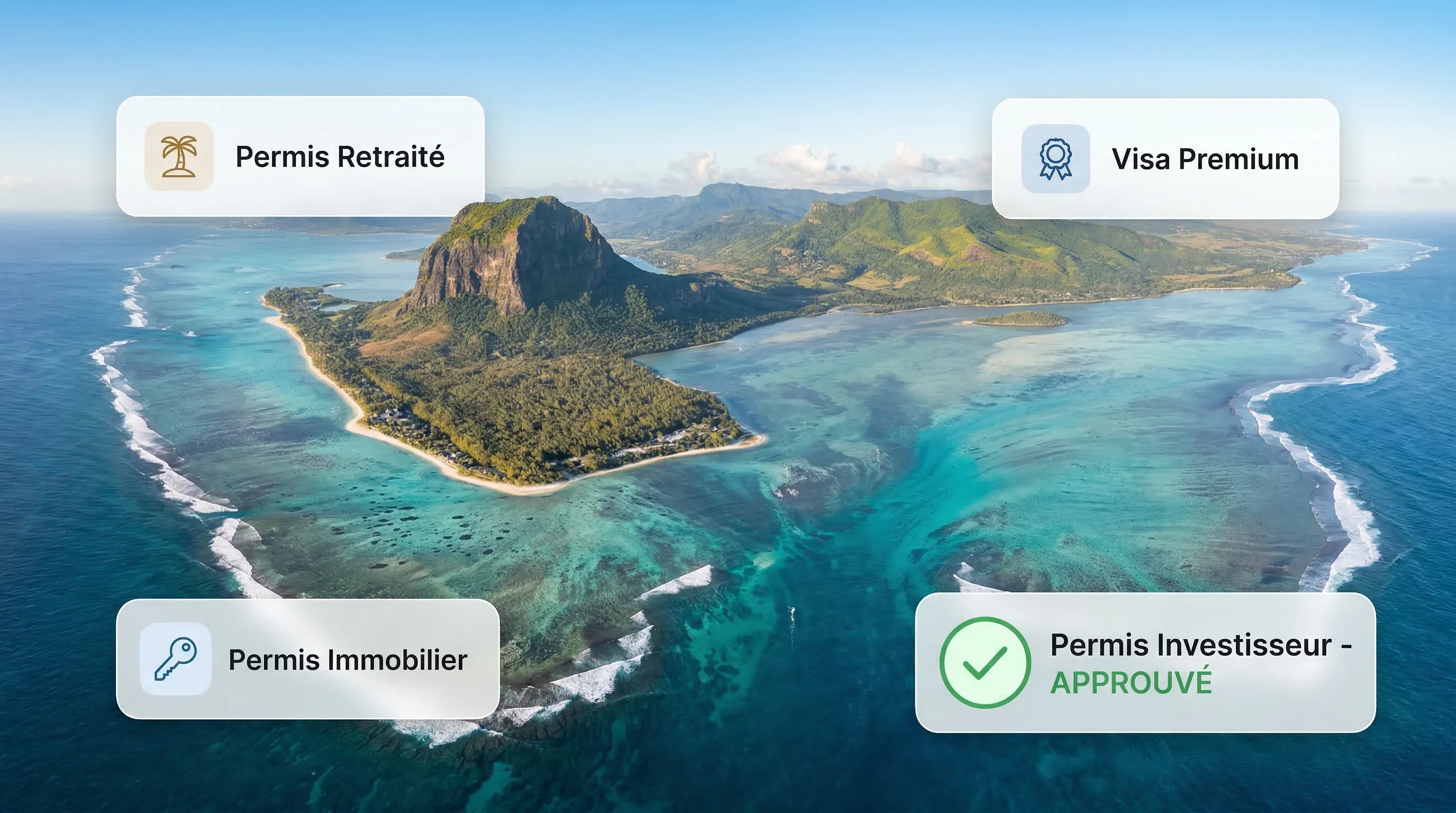
A progressive income tax from 0% to 20% for most residents (35% above Rs 12M), year-round sunshine, an English-friendly legal system and genuine political stability: it is easy to see why thousands of expats settle in Mauritius each year. The harder question is which route to take. This Mauritius residence permit guide walks you through every option, from the investor and work permits to the retirement, real estate and digital nomad routes, so you can match the right permit to your plans.
Occupation Permit vs Residence Permit: the big picture
Mauritius splits its long-stay routes into two families. Getting this distinction right is the first step in any Mauritius residence permit decision.
- Occupation Permits combine the right to work and the right to live in Mauritius in a single document, for people who invest, run a business or take a local job
- Residence Permits let you live in Mauritius without working locally, designed for retirees and qualifying property buyers
Both families can run for up to 10 years and extend to your spouse and children. The right choice depends on a single question: do you intend to earn an income locally, or to live off funds that come from abroad?
Did you know?
Almost every route in this guide is processed by the same body, the Economic Development Board (EDB). One agency, one online platform, and a single file standard, which makes Mauritius noticeably simpler than most relocation destinations.
Permits for working and doing business
If you plan to earn an income on the island, you will go through one of three occupation routes. Each rolls work authorization and residence into one permit.
The investor permit (for founders and business owners)
The investor permit is built for entrepreneurs who want to create or run a company in Mauritius. You transfer USD 100,000 into a Mauritian company account within 60 days of approval (the former USD 50,000 option was removed in August 2026), and crucially that money stays yours through your company, available to withdraw as dividends. The EDB then expects a minimum turnover of Rs 5M (~USD 110,000) from year 3, then Rs 8M (~USD 175,000) from year 5; permits already issued are assessed against the previous criteria at their first renewal. It is the only route that lets you hire freely and build a real team on the ground, and it runs for 10 years, renewable.
Best for: founders, business owners and anyone whose project involves staff, premises or selling on the local market.
The self-employed permit (for freelancers and consultants)
Consultants, designers, developers and other independent professionals fit the self-employed permit, which is reserved for the services sector. You transfer USD 50,000 to your own personal account within 60 days (the funds stay fully available to you) and provide at least three letters of intent, two of them from Mauritian clients. Turnover targets are lighter than the investor route: Rs 2M (~USD 44,000) from year 3, then Rs 3M (~USD 66,000) from year 5. Like the investor permit, it lasts 10 years.
Best for: solo professionals selling services who do not need staff or physical premises.
The work permit (for employees)
Hired by a Mauritian or international company? The employer files your work permit (the Professional Occupation Permit) with the EDB. Since August 2026 there is a single salary threshold: at least MUR 50,000 per month, across all sectors (the former ProPass and Expert Pass tiers were merged; current holders are assessed against the previous threshold at their first renewal only). There is no investment to make, and the permit length is aligned with your contract, up to 10 years.
Best for: salaried professionals with a local job offer.
Good to know
On a work permit, leaving or losing your job is not automatic grounds to leave the country, but it does start a clock: your employer must notify the EDB, and any change of employer means a fresh application. If you would rather not depend on one company, switching later to an investor or self-employed permit is straightforward.
Permits for living without working locally
Not everyone comes to Mauritius to work. If your income arrives from abroad, whether a pension, investments or remote clients, one of these routes will suit you better.
New since August 2026: Mauritius has also created a Golden Visa, a renewable 2-year residence for large investors, with detailed criteria still to be set by regulation. More details to come.
The retirement permit (for over-50s)
The retirement permit is the favorite of expat retirees, and one of the most accessible routes overall. You must be 50 or over, make an initial transfer of USD 2,000, and then transfer USD 2,000 per month (USD 24,000 per year) into a Mauritian bank account. The source does not matter: pension, rental income or savings all count. It runs for 10 years, renewable. You cannot take paid local employment, but you are free to invest passively in local companies.
Best for: retirees and financially independent people aged 50 and above.
Real estate residency (for property buyers)
Buying a qualifying home is itself a path to residence. Under real estate residency, purchasing a property worth at least USD 375,000 within an approved scheme (PDS, IRS, RES or Smart City) grants residence to you, your spouse and your children for as long as you own it, with no income condition attached. As a foreign buyer you hold full freehold ownership, and there is no capital gains tax on the resale.
Best for: buyers who want a home and an appreciating asset that also unlocks residency.
The Premium Visa: a route for digital nomads
Remote work has its own dedicated track. The Premium Visa lets you live in Mauritius for up to one year, renewable, while working for clients or employers based outside the country. You show a monthly income of at least USD 1,500 per adult from foreign sources, hold health insurance covering Mauritius, and that is essentially it: no capital investment is required. The one firm rule is that you may not operate on the local Mauritian market.
Good to know
The Premium Visa is ideal for testing island life over a year. But if you already know you want to settle for the long term, starting on a 10-year occupation route gives you far more stability and a stronger tax footing from day one. Many of our clients use the Premium Visa first, then transition to an investor or self-employed permit as their project matures.
Shorter stays: the internship visa
For students and recent graduates, the internship visa covers placements of 3 to 6 months, matching most school and university agreements. Mauritian companies typically offer a stipend of MUR 15,000 to MUR 30,000 per month, and a strong internship can convert into a 10-year professional permit if the company hires you.
Mauritius residence permit comparison table
Before you dig into the paperwork, use this table to spot the routes that fit your profile at a glance.
| Permit | Investment / income | Duration | Local work |
|---|---|---|---|
| Investor | USD 100,000 | 10 years | ✓ Yes |
| Self-employed | USD 50,000 | 10 years | ✓ Yes |
| Work (Professional) | ≥ MUR 50,000/month | Contract length | ✓ Yes |
| Retirement | USD 2,000/month | 10 years | ✗ No |
| Real estate | Property > USD 375,000 | While you own | ✗ No |
| Premium Visa | USD 1,500/month (foreign) | 1 year | ~ Remote only |
How to apply, step by step
Whichever Mauritius residence permit you choose, the process follows the same logic, and almost everything runs through the EDB.
- Pick the right route use the table above to match a permit to your goals and budget
- Build your file business plan, employment contract, proof of income or letters of intent, depending on the route
- Submit to the EDB through its online platform (for a work permit, the employer files on your behalf)
- Transfer the funds within 60 days of approval, into the relevant Mauritian account
- Collect your permit once the file is approved and funds are confirmed
Common requirements across most routes include a passport valid for at least six months, a clean criminal record, a recent medical certificate and the standard government fees. A complete, well-prepared file is the single biggest factor in a fast decision.
Frequently asked questions
What is the difference between an Occupation Permit and a Residence Permit in Mauritius?
An Occupation Permit is a combined work-and-residence permit for people who invest, run a business or take up employment, covering the investor, self-employed and professional categories. A Residence Permit lets you live in Mauritius without working locally, and covers retirees and qualifying property buyers. Both can run for up to 10 years and cover your family.
Which Mauritius residence permit is the cheapest to obtain?
The Premium Visa has no investment requirement, only proof of USD 1,500 per month in foreign income, but it is a 1-year route. For long-term settlement, the retirement permit is the most accessible: an initial transfer of USD 2,000, then USD 2,000 per month. The work permit also requires no capital, just a job offer meeting the salary threshold.
Can I work in Mauritius on a residence permit?
It depends on the route. The investor, self-employed and work permits all grant the right to work locally. The retirement permit and real estate residency do not allow paid local work, though holders may invest passively. The Premium Visa only allows remote work for clients or employers based outside Mauritius.
How long does a Mauritius residence permit last?
The investor, self-employed and retirement permits are issued for up to 10 years and are renewable. The work permit is aligned with your employment contract, up to 10 years. Real estate residency lasts for as long as you own the qualifying property, and the Premium Visa is valid for 1 year, renewable.
Do I need to buy property to get residency in Mauritius?
No. Buying property worth at least USD 375,000 in an approved scheme is one route to residency, but it is optional. Most expats obtain residency through an investor, self-employed, work or retirement permit, none of which require a property purchase.
Official sources
Immigration and tax rules are sensitive, so always cross-check the figures above against the official authorities before you commit:
- Economic Development Board (EDB) the official agency for occupation and residence permits
- Mauritius Revenue Authority (MRA) income tax rates and double-taxation treaties
Not sure which permit fits your project?
The BlueVisa team matches you to the right route and handles the file end to end, whether that means an investor permit, a self-employed permit, a work permit, the retirement permit or real estate residency.
Discuss my project