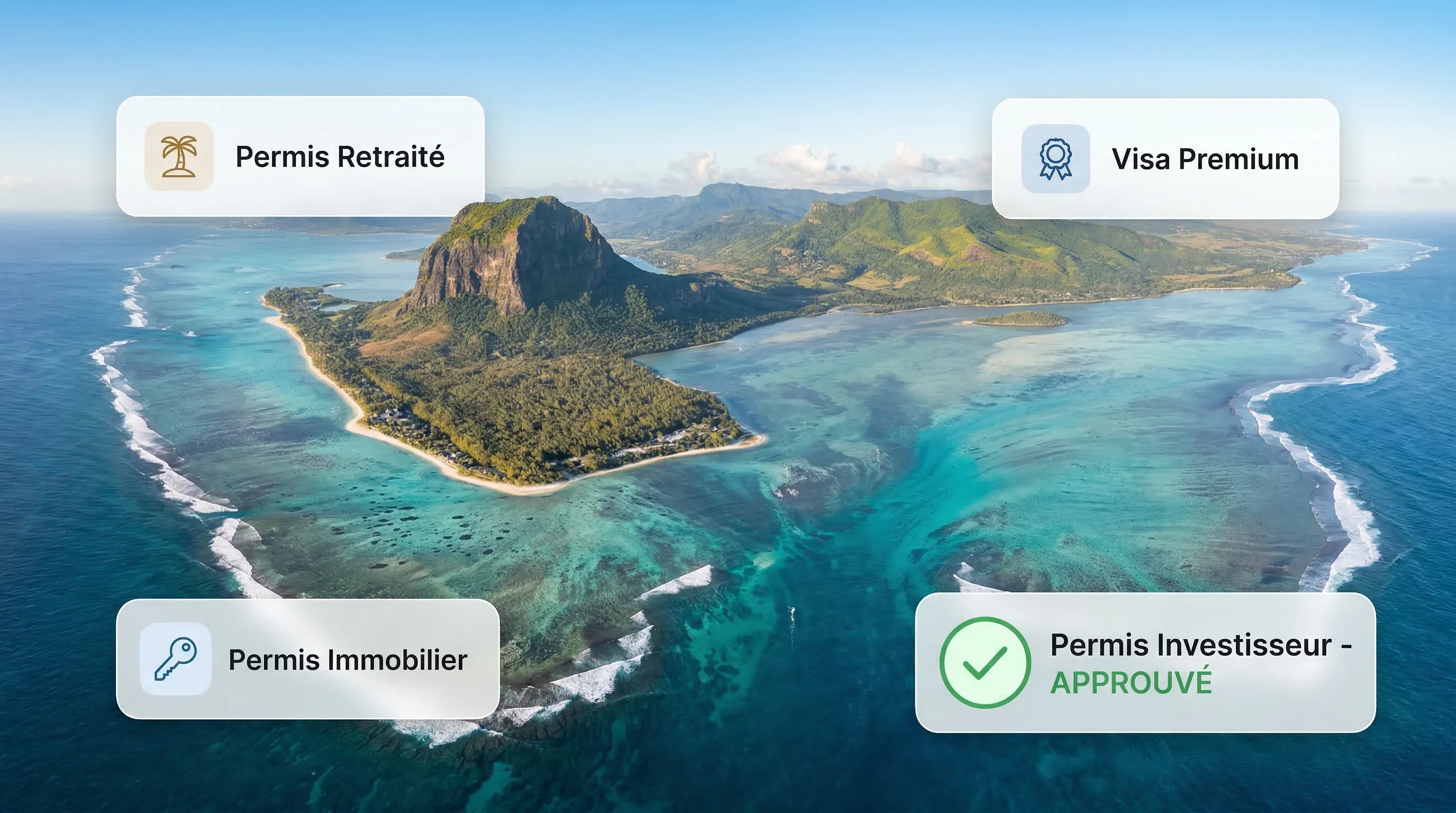
The Mauritius Finance Act 2026 and its accompanying economic measures amend several of the conditions that matter when you relocate to Mauritius. If you are planning a move, or already hold an Occupation Permit, four changes deserve your attention.
The good news first: the fiscal fundamentals that make Mauritius attractive are untouched. What moves are the entry and renewal thresholds of the permits, plus the taxation of very high incomes.
Investor permit: one entry ticket, at USD 100,000
This is the most structural change. The investor permit used to offer two investment options, USD 50,000 or USD 100,000. The USD 50,000 option is gone: you now transfer USD 100,000 into your company's Mauritian bank account, within 60 days of approval.
The nature of the funds does not change: the money becomes your company's capital and remains recoverable, notably through a shareholder's current-account loan. It is never locked.
The turnover targets also evolve, on a more progressive schedule than before: Rs 5M from year 3 (around USD 110,000), then Rs 8M from year 5 (around USD 175,000). The innovative start-up route, assessed case by case through the EDB or an accredited incubator, is preserved.
Self-employed permit: same deposit, new turnover targets
For freelancers and consultants, the self-employed permit keeps its entry ticket: USD 50,000 transferred to your personal bank account, with the funds staying fully available.
What changes are the renewal criteria: the EDB now expects turnover of Rs 2M from year 3 (around USD 44,000), then Rs 3M from year 5 (around USD 66,000). The first two years carry no imposed threshold, which leaves time to build your client base.
Work permit: a single threshold at MUR 50,000
For employees, the two historical tiers disappear: the ProPass (MUR 30,000) and Expert Pass (MUR 250,000) categories are merged into a single work permit, with a minimum salary of MUR 50,000 per month (around €1,000), across all sectors.
Good to know: what if you already hold a permit?
According to early analyses by tax advisory firms, permits already issued are assessed against the previous criteria at their first renewal: a ProPass holder, for instance, keeps the MUR 30,000 threshold for that deadline. Confirm your own case with the EDB before renewing.
Golden Visa: a new scheme for large investors
Mauritius now has its own Golden Visa: a renewable 2-year residence, granted on the EDB's recommendation, covering your spouse and dependents. It can lead to permanent residence after USD 1M invested within 12 months, excluding property bought under the approved residential schemes. The planned tax regime mirrors that of the premium visa (remittance-based taxation).
The precise sectors and criteria are still to be set by regulation: we will update this page as soon as they are published. Do not confuse it with real estate residency, which is unchanged at USD 375,000. Also worth noting: the little-used Family Occupation Permit is abolished.
Income tax: a 35% bracket above Rs 12M
On the tax side, the Finance Act 2026 adds a top bracket to the personal income tax scale, applicable from the income year starting 1 July 2026:
| Annual taxable income | Rate |
|---|---|
| Up to Rs 500,000 | 0% |
| Rs 500,001 to Rs 1M | 10% |
| Rs 1M to Rs 12M | 20% |
| Above Rs 12M (≈ €230,000) | 35% |
In practice, this bracket only concerns very high earners: below Rs 12M of taxable income per year, nothing changes. The individual Fair Share Contribution of 15%, which only applied to the 2025/26 year, disappears in favour of this bracket. For companies, the 5% contribution above Rs 24M of turnover remains in place. The official scale is published by the Mauritius Revenue Authority.
Did you know? Property rules move too
The 2025 seller surcharge (Land Transfer Tax raised to 10%) is repealed: back to 5%. In exchange, a new additional 10% duty, borne by the seller, applies to the sale of residential property located on State land or Pas Géométriques to a non-citizen. The 10% registration duty for non-citizen buyers is unchanged.
What the Finance Act 2026 does not change (and it is the essential part)
The tax appeal of Mauritius rests on fundamentals that the 2026 finance laws leave untouched:
- corporate tax at 15%
- Mauritian dividends exempt (0%)
- no capital gains tax
- foreign income taxed only if received in Mauritius (remittance basis)
- tax residency from 183 days of presence per year
- premium visa and retirement permit (USD 2,000/month) unchanged
- real estate residency still at USD 375,000
In other words, for the vast majority of profiles (entrepreneurs, freelancers, employees, retirees), Mauritius remains exactly as attractive as before. The new thresholds mainly raise the level of ambition expected from investment projects.
Frequently asked questions
What is the new minimum investment for the investor permit?
USD 100,000, transferred into your company's Mauritian bank account within 60 days of approval. The USD 50,000 option was removed in August 2026. The funds remain recoverable through a shareholder's current-account loan.
Is my existing permit affected by the new thresholds?
According to early analyses by tax advisory firms, permits already issued are assessed against the previous criteria at their first renewal only. Confirm your own situation with the EDB before your renewal date.
Who is affected by the new 35% tax bracket?
Only taxable income above Rs 12M per year, roughly €230,000. Below that level the scale remains 0% up to Rs 500,000, then 10% and 20%: nothing changes for the vast majority of expats.
What is the Mauritius Golden Visa?
A new scheme created in August 2026: a renewable 2-year residence for large investors, covering spouse and dependents, with permanent residence possible after USD 1M invested within 12 months. The detailed criteria are still to be set by regulation.
Has the self-employed permit deposit changed?
No. The deposit remains USD 50,000 into your personal Mauritian bank account, and the funds stay freely available. Only the turnover targets change: Rs 2M from year 3, then Rs 3M from year 5.
Is your project affected by the new thresholds?
BlueVisa already applies the 2026 rules across all its services: investor permit, self-employed permit, work permit, business plans built on the new EDB criteria, banking, tax and relocation.
Review my project