Learning how to open a bank account in Mauritius is one of the most underrated steps of a move to the island. It looks simple on paper, but it can quickly slow down an entire relocation if you prepare it too late or with the wrong documents. This guide walks foreigners, non-residents and new arrivals through what banks really want to see.
Why your Mauritius bank account matters from day one
When you plan a move to Mauritius, you naturally think first about the permit, housing, schools, health insurance or shipping your belongings. The bank account usually comes later, treated as a final formality once everything else is sorted.
That is a mistake. For a foreigner, a local bank account structures a big part of daily life on the island: receiving a salary, paying rent, settling school fees, transferring savings, setting up a local company, organizing business flows and showing that your relocation is genuine.
In Mauritius this matters even more, because some permits require transfers of funds within a strict deadline after your file is approved. Banking is not separate from your relocation project: it is part of it.
Did you know?
A bank does not only want to know who you are. It wants to understand the logic of your move, the source of your funds and the economic flows you are about to create. The clearer that story, the smoother your account opening.
What Mauritian banks really want to understand
Mauritian banks apply strict rules on compliance, anti-money-laundering and the exchange of tax information. So they go well beyond a simple identity check.
In practice, the bank wants to understand why you are opening an account in Mauritius, where the money comes from, which countries are involved, what your tax residency is, which activity generates your income and what transaction volumes to expect.
The more international your profile, the more this consistency matters. An entrepreneur who invoices clients in Europe, still holds accounts in their home country, sets up a Mauritian company and transfers funds from several countries needs to be able to explain the whole picture simply and with documents to back it up.
Which bank should you choose in Mauritius?
Mauritius has a well-structured banking sector, supervised by the Bank of Mauritius. Among the banks BlueVisa may work with depending on the profile, you will find names such as MCB, Absa Bank Mauritius, Bank One and HSBC Mauritius.
Thanks to our banking partners, we can steer files toward the contacts best suited to each client: personal account, company account, international activity, wealth management or multi-currency flows.
The right instinct is not to hunt for "the best bank" in the abstract. The better question is: which bank fits your status, your flows and your actual usage?
A salaried expat does not have the same needs as a retiree, a freelancer, an investor or a Mauritian company. Some banks are better for everyday life, others for entrepreneurs, companies, international wealth or multi-currency operations.
Profiles linked to crypto need to be especially careful. It is not necessarily impossible, but the file is more sensitive and must be structured methodically, because each bank has its own risk appetite. A well-presented crypto profile, with documented flows, has nothing in common with a vague or poorly evidenced application.
Resident vs non-resident account in Mauritius
Depending on your situation, you can open as a resident or a non-resident. This distinction shapes the documents requested, the products you can access and the way the bank analyzes your file.
In some cases it is possible to open a non-resident account before you hold a Mauritian address, especially when your permit approval already exists. But that depends on the bank, its internal policy and the quality of the file you present. Some banks can even consider a remote opening through an intermediary approved by the Financial Services Commission.
A resident current account, a non-resident account, a premium account, a multi-currency account and a company account do not follow the same criteria. So avoid treating every bank account as if it were the same thing.
Documents needed to open a bank account in Mauritius
The documents requested vary by bank and profile, but the main building blocks are usually the same. For a personal account, you will generally need to prepare:
- a valid passport
- a recent proof of address, often under three months old (a utility bill works well)
- proof of income or activity
- recent bank statements, depending on the profile
- a tax identification number
- your residence permit or permit approval when available
Some banks may ask for extras: an employment contract, an employer letter, proof of income, a tax-residency declaration, documents on the source of funds or details on how you plan to use the account. A reference letter from your home bank is also common.
Good to know
A proof of address that is too old, a document in the wrong name or a poorly explained source of income can be enough to stall the opening. The bank can always ask for more than the standard list.
Personal, professional or company account
For entrepreneurs and freelancers, one common mistake is to mix personal and business flows. It feels convenient in the short term, but it quickly becomes confusing for the bank, your accountant and the tax authorities.
The personal account is for daily life: rent, card payments, insurance, school, everyday spending and personal transfers. The professional or company account is for collecting client payments, paying suppliers, tracking the books, receiving startup funds and proving real economic activity.
For a Mauritian company, the expected documents may include the Certificate of Incorporation, the Business Registration Card, a board resolution or minutes authorizing the account opening, documents for directors, shareholders and ultimate beneficial owners, plus a business plan stating the source of funds.
Source of funds: the most sensitive part of your file
The source of funds is often where everything is decided. The bank does not just want to know that you have the money. It wants to understand where it came from and to be able to verify that explanation.
Possible sources include accumulated salaries, dividends, the sale of a business, a property sale, personal savings, a retirement pension or professional income.
So you need to prepare the matching evidence: bank statements, deeds of sale, payslips, dividend documents, tax records, contracts, invoices or anything else that shows traceability.
A clear file does not guarantee automatic acceptance, but a vague file almost always increases the delay. In Mauritius, a stalled file can easily take several weeks, sometimes several months.
How long does it take to open a bank account in Mauritius?
In practice, plan for roughly 2 to 3 weeks to open a bank account in Mauritius when the file is complete, consistent and the bank does not need special investigations.
That timeline can exceed one month if your profile calls for deeper checks: a complex source of funds, international activity, a newly formed company, flows between several countries, crypto assets, incomplete documents or inconsistencies between the permit, the tax residency and the banking activity expected.
The smart move
Do not wait until you land to prepare your banking file. The earlier your documents and the explanation of your flows are ready, the easier it is to avoid back-and-forth with the bank.
How your bank account links to your residence permit
Your bank account can be directly tied to your permit. For some profiles, the initial transfer — USD 100,000 for the investor permit (into the company account), USD 50,000 for the self-employed permit (into your personal account) — must be made from abroad into the relevant Mauritian account within 60 days of the permit being issued.
Depending on the permit, the required account can be personal or corporate. For an investor, the transfer is usually made to the bank account of the Mauritian company. For a self-employed applicant, it goes to the Mauritian bank account linked to the activity.
If the deposit is not made within the set deadline, the permit can be called into question. That is why account opening must be anticipated from the very start of the project, not handled as an afterthought.
Other statuses, such as the work permit or the retirement permit, also require clear banking organization, even though the initial-transfer logic is different.
Plan ahead
The bank account, the source of funds and the transfers should be mapped out from the start of your permit application.
Avoid this
Waiting for permit approval only to discover the bank wants extra supporting documents.
Tax residency and reporting: avoid the mismatches
Opening a bank account in Mauritius does not make you invisible to tax. Banks take part in international transparency mechanisms, notably the Common Reporting Standard (CRS).
In concrete terms, the bank may ask you to declare your tax residency and to complete a self-certification. Certain information can then be shared with the relevant tax authorities through automatic exchange.
So if you are moving to Mauritius, your bank account should sit within a consistent setup: a clear Mauritian address, real local flows, an explained activity, a documented source of funds and tax handled cleanly. Our guide to Mauritius tax residency goes deeper on this.
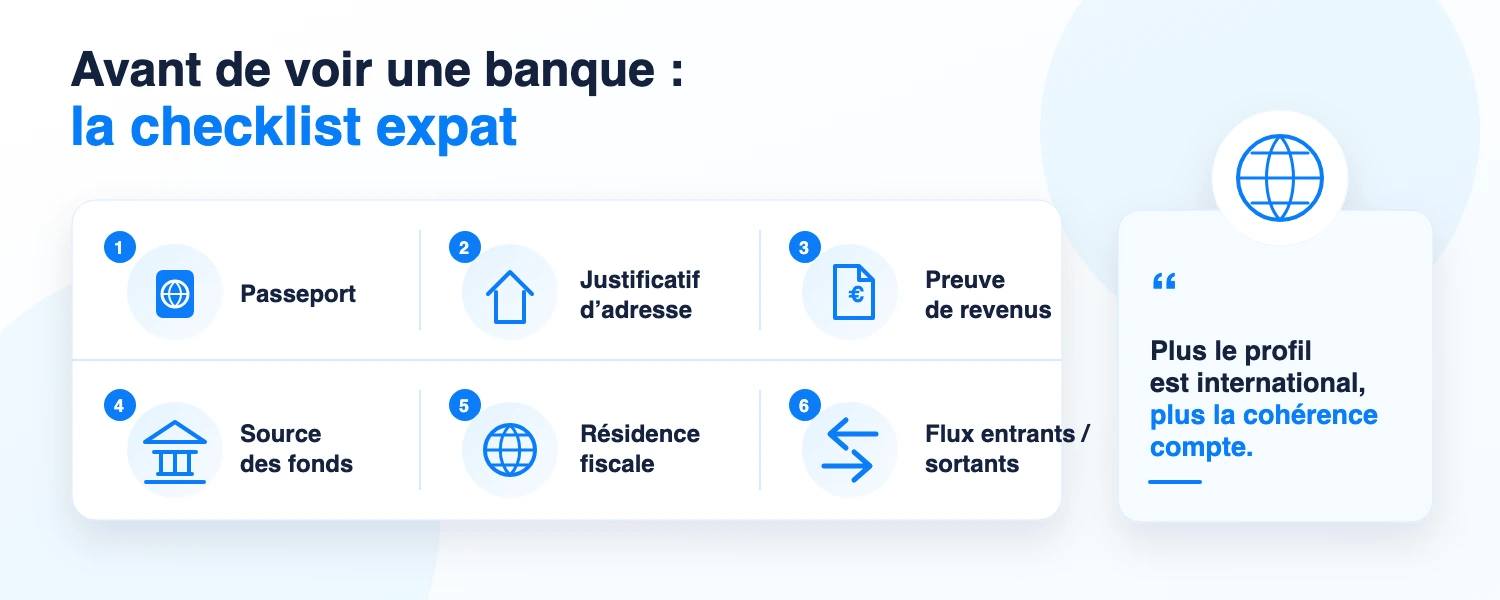
Checklist before your bank appointment
Before you meet a bank, prepare a simple, readable and complete file. Here is what to gather first:
- a valid passport
- a recent proof of address
- proof of income or activity
- recent bank statements
- a tax identification number
- a documented source of funds
- your country of tax residency
- an estimate of incoming and outgoing flows
- the currencies you use
- corporate documents if you are opening a company account
- contracts, invoices or letters of intent where relevant
As an entrepreneur, you also need to explain simply what your activity does, who pays you, from which countries, how often, why a local account is necessary and how the business will be run from Mauritius.
The mistakes that delay files the most
Delays rarely come from a single missing document. They mostly come from a file that leaves too many gray areas.
- a proof of address that is too old
- a home address, a local address and a tax residency that are poorly explained
- a vague source of funds
- incomplete corporate documents
- an activity described too generically
- a mismatch between the visa requested and the expected banking flows
- confusion between a personal account and a company account
- poorly documented crypto flows
- a rush to move fast without a complete file
The key point is simple: banks do not like gray areas. If your situation is complex, that is not necessarily a problem. But it has to be explained cleanly.
Official and useful sources
Banking and permit rules are sensitive topics, so always cross-check against the official authorities:
- Bank of Mauritius the central bank that supervises the banking sector
- Economic Development Board (EDB) the official agency for residence and occupation permits
Frequently asked questions
Can a foreigner open a bank account in Mauritius without being a resident?
Yes. Mauritian banks offer non-resident accounts, and it is often possible to open one before you hold a local address, especially once a permit approval already exists. Acceptance, documents and minimum balances vary from one bank to another, so each case is assessed individually.
What documents do I need to open a bank account in Mauritius?
For a personal account you typically need a valid passport, a recent proof of address (usually under three months old), proof of income or activity, recent bank statements, a tax identification number and, when available, your residence permit or permit approval. Banks may request more.
Which is the best bank in Mauritius for expats?
There is no single best bank for everyone. Mauritius has a well-regulated banking sector supervised by the Bank of Mauritius, including MCB, Absa Bank Mauritius, Bank One and HSBC Mauritius. The right choice depends on your profile: employee, retiree, freelancer, investor, company or international wealth.
Do I need a Mauritian bank account for the investor permit?
Yes. For the investor permit, the required USD 100,000 must be transferred from abroad into the Mauritian bank account of the company within 60 days of the permit being issued. If the transfer is not made in time, the permit can be called into question.
Can a foreigner open a company bank account in Mauritius?
Yes, but the bank will require full corporate documentation: certificate of incorporation, business registration card, a board resolution authorizing the account, documents for directors, shareholders and ultimate beneficial owners, plus a business plan and the source of funds.
Can a Mauritian bank refuse my application?
Yes. Even with a permit, the bank keeps its own compliance review and can ask for extra documents or decline a profile that does not match its criteria. A clear, well-documented file is the best way to avoid delays and refusals.
Planning your move to Mauritius?
A successful relocation is not just about the permit. BlueVisa helps you align your banking file with your move, your status, any company you set up and your economic flows. Thanks to our banking partners and our experience with international profiles, including crypto, we can structure sensitive files more clearly and make them easier to defend. We handle the investor permit, the self-employed permit and the retirement permit.
Discuss my project